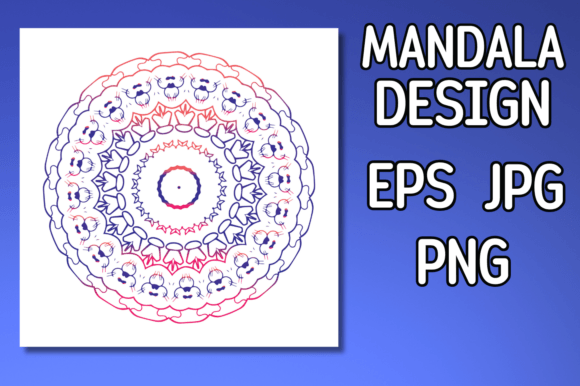
Gradiant Mandala: A Comprehensive Evaluation for Design Projects
In the landscape of digital graphic assets, finding a balance between aesthetic appeal and technical versatility is essential for professionals and hobbyists alike. The Gradiant Mandala represents a specific category of vector-based artwork designed to bridge this gap. By combining intricate geometric patterns with smooth color transitions, this design serves as a foundational element for a wide array of print and digital applications. This evaluation explores the utility, specifications, and practical applications of these files to help creators determine if they align with their current project requirements.
Understanding the Gradiant Mandala Design
A mandala, traditionally defined as a spiritual and ritual symbol in Hinduism and Buddhism representing the universe, has evolved into a popular motif in modern graphic design. The Gradiant Mandala variant distinguishes itself through the use of gradient fills rather than solid colors. This technique adds depth, dimension, and a contemporary feel to the radial symmetry that characterizes traditional mandalas. Unlike flat illustrations, the inclusion of gradients allows the design to interact dynamically with light and texture, making it particularly suitable for high-impact visual communications.
The core value of this asset lies in its format. Typically delivered as a single EPS (Encapsulated PostScript) file alongside a standard JPG preview, the design offers a dual approach to usage. The EPS file is crucial for designers who require full editability, allowing for modifications to color palettes, scaling without loss of quality, and integration into complex layouts. The accompanying JPG file provides an immediate, ready-to-use option for quick projects where editing capabilities are not necessary.
Key Benefits for Print and Digital Applications
The versatility of the Gradiant Mandala makes it a robust choice for various industries. Its primary advantage is the ability to scale infinitely while maintaining crisp edges, a critical feature for professional printing. Below are the specific areas where this design excels:
- Business Cards and Stationery: The intricate details of the mandala add a touch of sophistication to corporate identity materials. When printed on high-quality cardstock, the gradients can create a subtle sheen or depth that elevates the perceived value of the brand.
- Invitations and Greeting Cards: For events ranging from weddings to birthdays, the symmetrical nature of the mandala provides a sense of harmony and celebration. The colorful image aspect ensures that these cards stand out in a mailbox filled with generic designs.
- Textile and Apparel Design: The seamless potential of mandala patterns makes them ideal for T-shirts, fabric prints, and decals. The vector format ensures that the design can be adjusted to fit different garment sizes without pixelation.
- Coloring Pages and Crafts: While the provided version is colorful, the vector structure allows users to convert the lines into black-and-white outlines. This transforms the asset into a unique coloring page for educational or recreational purposes.
- Stickers and Decals: For small-scale applications like laptop stickers or car decals, the high-resolution capability of the EPS file ensures that fine details remain visible even at reduced sizes.
Technical Specifications and Usability
When evaluating the technical delivery of the Gradiant Mandala, the inclusion of both editable and static formats is a significant consideration. The EPS file is compatible with industry-standard software such as Adobe Illustrator, CorelDRAW, and Inkscape. This compatibility grants the user the freedom to manipulate the gradient stops, change the hue of specific segments, or isolate individual elements of the pattern.
Conversely, the JPG file serves as a convenient backup or final output for non-designers. It eliminates the need for specialized software, allowing for direct upload to online printing services or social media platforms. However, users should note that the JPG is a raster format; while high-quality, it does not offer the same scalability as the vector counterpart. If the design needs to be enlarged significantly beyond its original dimensions, the JPG may exhibit pixelation, whereas the EPS will remain sharp.
Situations Where This Design Is a Strong Fit
The Gradiant Mandala is particularly well-suited for projects that demand a blend of artistic flair and structural precision. It is an excellent choice when:
- Brand Identity Requires Uniqueness: Businesses looking to differentiate themselves from competitors using standard clip art will find the unique and beautiful design profile beneficial. The gradient effect adds a layer of complexity that simple icons lack.
- High-Quality Printing is Required: For commercial printing jobs where resolution is paramount, the vector nature of the EPS file ensures that the output meets professional standards.
- Customization is Necessary: If a project requires matching a specific brand color palette, the ability to edit the EPS file allows for precise color matching, which is impossible with pre-rasterized images.
- Multi-Media Usage: Creators who need to use the same design across multiple mediums (e.g., a website banner, a physical flyer, and a T-shirt) benefit from the single source of truth provided by the vector file.
Considerations and Potential Tradeoffs
While the Gradiant Mandala offers numerous advantages, there are tradeoffs and considerations that potential users must weigh before purchasing or downloading.
Software Requirements: Access to the full potential of the design requires vector editing software. Users relying solely on basic image viewers or mobile apps may struggle to utilize the EPS file effectively. In such cases, the JPG becomes the only viable option, limiting the scope of customization.
File Complexity: High-quality vector files with complex gradients can sometimes be resource-intensive. Opening large EPS files on older computers or less powerful hardware may result in slower rendering times. Additionally, exporting these files to certain legacy print formats may occasionally require simplification of the gradient meshes to ensure compatibility.
Design Specificity: The "colorful" nature of the image described in the product details implies a vibrant aesthetic. While attractive for many, this style may not align with minimalist or monochromatic branding guidelines. In scenarios where a stark, black-and-white look is preferred, the initial gradient-heavy design might require significant modification or may simply be unsuitable without altering the fundamental look of the asset.
Determining Suitability for Your Goals
To decide if the Gradiant Mandala aligns with your needs, consider the following decision-making framework. First, assess your intended output medium. If the goal is large-format printing or scalable web graphics, the vector component is indispensable. Second, evaluate your workflow. Do you have the time and tools to edit a vector file? If yes, the EPS file offers superior long-term value. If you need a quick solution for a one-off print job, the JPG may suffice.
Alternatives may be worth considering if your project demands a completely abstract style or if you require a specific cultural motif that differs from the traditional mandala structure. Furthermore, if your budget is extremely constrained and you do not require ownership rights for modification, free public domain alternatives might be sufficient, though they often lack the specific gradient polish of premium vector sets.
In conclusion, the Gradiant Mandala stands out as a versatile tool for creatives seeking to enhance business cards, invitations, textiles, and crafts. Its combination of a unique design, high-quality vector formatting, and ready-to-use options provides a balanced solution for diverse printing needs. By understanding the strengths of the EPS and JPG formats and acknowledging the requirements for vector editing, users can make an informed decision that maximizes the utility of this design asset.